
A digital marketer wants to create an audience that allows personalization of the website in real time. Which method would the marketer need to consider to ensure real-time personalization is achieved effectively?
In the context of Adobe's Real-Time CDP, what defines an Identity Graph?
A financial services customer wishes to suppress people from active credit card campaigns as soon as they submit an application for the associated credit card name. The business's goal is to optimize ad spend by suppressing people quickly who convert and use the savings to help funnel more money back into their acquisition strategies. The current data model that IT has provided from their data warehouse looks like the following:
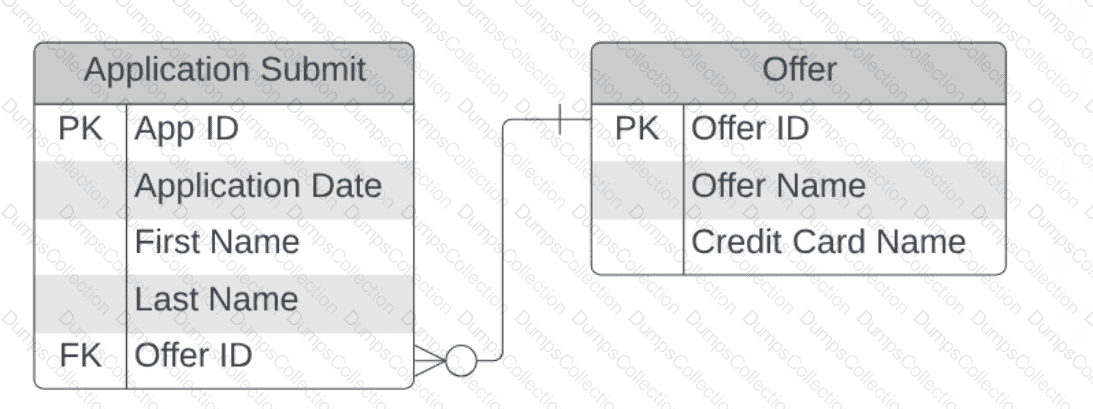
It is assumed that each application submit contains an offer that is always associated to a credit card name. Assuming all applications are streamed into the Real-Time Customer Profile, in which two ways could a developer model the application submit event to ensure the real-time suppression requirement is supported? (Choose two.)
A gaming company wants to send user's gaming event data from the console to Adobe Experience Platform through Adobe Experience Platform Server API and Edge Network for serving personalized experiences at a later stage. In the Server API call what is the right endpoint to use to send the data to Adobe Experience Platform after the company configures the necessary Schema, Dataset and Datastream?
A data engineer is troubleshooting an issue where clickstream data being ingested via Adobe's Web SDK into Adobe Real-Time CDP is not populating the desired segment. The segment is looking for visitors who have added an item to their cart but have not made a purchase in over 30 days. The source data consists of user interactions, collected in real-time. It is available in a structured format and includes information like click timestamp, visitor ID, event type (page view, item added to cart, purchase, etc.), and item details.
What is the possible cause for the error when trying to create the Edge Segment?
A data analyst is trying to apply a series of complex conditions to filter audiences in Adobe Real-Time CDP for a client's online sale event. What would be the two recommended courses of action in terms of segment creation in this situation? (Choose two.)
A retail organization is Introducing an e-commerce channel and would like to integrate the customer's browsing and online purchase data into the Real-Time Customer Profile The data structure of the clickstream event being captured is as follows:
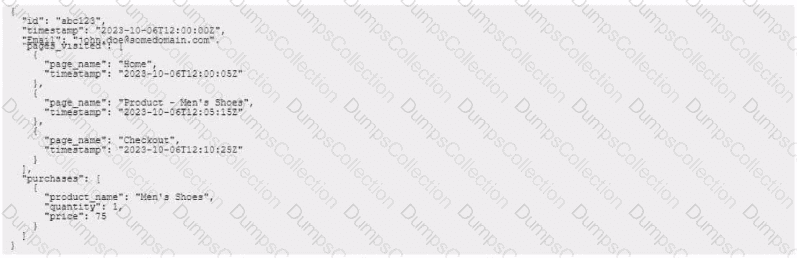
The architect decides to separate 'pages.vislted" and 'purchases' Into different schemas.
Which Experience Data Model XDM schema classes would be used to model the browsing activity and the purchase activity?
A customer has an ongoing scheduled batch dataflow (S3 source connector) that runs in every 8 hours starting 2 PM UTC. The customer requested for a schedule update to change the start time to 3 PM UTC and to run in every 6 hours. Which is the best possible solution to achieve that?
A data architect is tasked with designing an Adobe Experience Platform architecture for a multi-channel retail business. Which two identity namespaces would be used to model the identities on the dataset of online and offline transactions? (Choose two.)
A marketing firm wants to create an audience for their new campaign focusing on repeat customers. What should they use in Adobe Real-Time CDP to build this audience segment considering recency and frequency of the customer visits?

TESTED 17 Oct 2026