
While developing a new functionality for a website in developer mode with all cache types enabled, an Adobe Commerce Developer needs to add \Magento\Sales\Model\Service\InvoiceService SinvoiceService as a new dependency to an existing page action controller in Vendor\CustomModule\Controller\Index\Index . This is accomplished as follows:

After cleaning the f ull_page cache and reloading the page, the developer encounters the following exception:
Recoverable Error: Argument 2 passed to Vendor\CustomModule\Controller\Index\Index::__construct() must be an instance of
\Magento\Sales\Model\Service\InvoiceService [...]
Which action should the Architect recommend to the developer to fix this error?
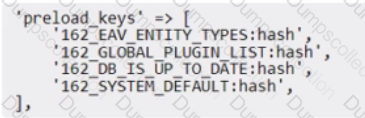
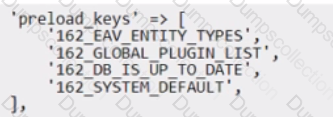
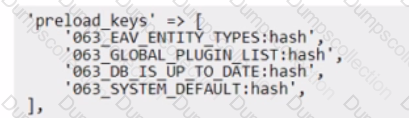
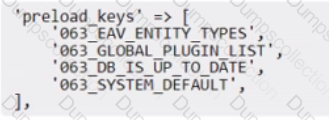
An Architect is configuring the preload.keys for Redis on an Adobe Commerce on-premise instance.
The Architect discovers that the following cache keys are loaded on each frontend request: EAV_ENTITY_TYPES, GLOBAL_PLUGIN_LIST, DB_IS_UP_TO_DATE, SYSTEM_DEFAULT.
• The id_prefix of the frontend => page_cache is set to 063_.
• The id_pref ix of frontend => default is set to 762_.
• The Architect has enabled and configured Redis L2 caching.
How should the preload.keys be configured?
A)
B)
C)
D)
An Adobe Commerce Architect is troubleshooting an issue on an Adobe Commerce Cloud project that is not yet live.
The developers copied the Staging Database to Production in readiness to Go Live. However, when the developers test their Product Import feature, the new products do not appear on the front end.
The developers suspect the Varnish Cache is not being cleared. Staging seems to work as expected. Production was working before the database migration.
What is the likely cause?
An Adobe Commerce Architect runs the PHP Mess Detector from the command-line interface using the coding standard provided with Adobe Commerce. The following output appears:

The Architect looks at the class and notices that the constructor has 15 parameters. Five of these parameters are scalars configuring the behavior of MyService. The class also contains three constants referencing one other class.
How should the Architect fix the code so that it complies with the coding standard rule?
An Architect working on a headless Adobe Commerce project creates a new customer attribute named my_attribute. Based on the attribute value of the customer, the results of GraphQI queries are modified using a plugin. The frontend application is communicating with Adobe Commerce through Varnish by Fastly. which is already caching the queries that will be modified. The Adobe Commerce Fastly extension is installed, and no other modifications are made to the application.
Which steps should the Architect take to make sure the vcl_hash function of Varnish also considers the newly created attribute?
An Adobe Commerce Architect designs a data flow that contains a new product type with its own custom pricing logic to meet a merchant requirement. Which three steps are required when adding a product type with custom pricing? (Choose three.)
A representative of a small business needs an Adobe Commerce Architect to design a custom integration of a third-party payment solution. They want to reduce the list of controls identified in their Self-Assessment Questionnaire as much as possible to achieve PCI compliance for their existing Magento application.
Which approach meets the business needs?
A merchant is using a unified website that supports native Adobe Commerce B2B and B2C with a single store view.
The merchant's objective is to display the B2B account features, such as negotiable quotes and credit limits, in the header of the site on every page for logged-in users who belong to a B2B company account.
Each B2B company possesses its unique shared catalog and customer group, while numerous customer groups for non-B2B customers undergo changes. The merchant insists that this association should not be linked to customer groups.
Which two solutions should the Architect recommend for consideration, taking into account public data and caching? (Choose two.)
An Adobe Commerce Architect needs to log the result of a ServiceClass:: getData method execution after all plugins have executed. The method is public, and there are a few plugins declared for this method. Among those plugins are after and around types, and all have sortOrder specified.
Which solution should be used to meet this requirement?
An Adobe Commerce Architect creates a stopword for the Italian locale named stopwordsjtJT.csv and changes the stopword directory to the following:
What is the correct approach to change the stopwords directory inside the custom module?

TESTED 17 Oct 2026