Pre-Summer Special Sale - 70% Discount Offer - Ends in 0d 00h 00m 00s - Coupon code: best70

Page: 1 / 2
Total 18 questions
Exam Code: CCFH-202b                Update: Apr 19, 2026
Exam Name: CrowdStrike Certified Falcon Hunter

CrowdStrike CrowdStrike Certified Falcon Hunter CCFH-202b Exam Dumps: Updated Questions & Answers (April 2026)

Question # 1

You identify an instance of a user in your environment utilizing a Cloudflared tunnel daemon, resulting in unusual command line activity. What steps would you take to determine if the unusual activity is malicious or legitimate?

A.

Block all instances of Cloudflared in your environment and perform a forensic investigation into the host

B.

Create a forensic image of the hard drive and analyze it for indicators of compromise

C.

Immediately network contain the host and perform a forensic investigation into the host

D.

Review the specific commands associated and compare them with known legitimate use cases to confirm if patterns align with normal operations

Question # 2

Falcon is generating detections for a malicious file evil.exe with varying filepaths on several hosts as end users attempt to execute the file. Which query can be used to proactively hunt where the file exists prior to the user executing it?

A.

#event_simpleName=ProcessRollup2 OR #event_simpleName=SyntheticProcessRollup2 | ImageFileName=/evil.exe/i | ImageFileName=/([\/\\])(? < FileName > \w*\.?\w*)$/ | stats count by aid, hostname, FileName, ImageFileName, CommandLine

B.

#event_simpleName=ProcessRollup2 OR #event_simpleName=SyntheticProcessRollup2 | aid=?aid | ImageFilePath=/C:\users\/ | ImageFileName=evil.exe | table([aid, hostname, FileName, ImageFileName, CommandLine], limit=1000)

C.

#event_simpleName=ProcessRollup2 OR #event_simpleName=SyntheticProcessRollup2 | aid=?aid | ImageFilePath=C:\users\*\evil.exe | table([aid, hostname, FileName, ImageFileName, CommandLine], limit=1000)

D.

#event_simpleName=ProcessRollup2 OR #event_simpleName=SyntheticProcessRollup2 | ImageFileName=/evil.exe/i | ImageFileName=/([\/\\])(? < FileName > \w*\.?\w*)$/ | table([aid, hostname, FileName, ImageFileName, CommandLine], limit=1000)

Question # 3

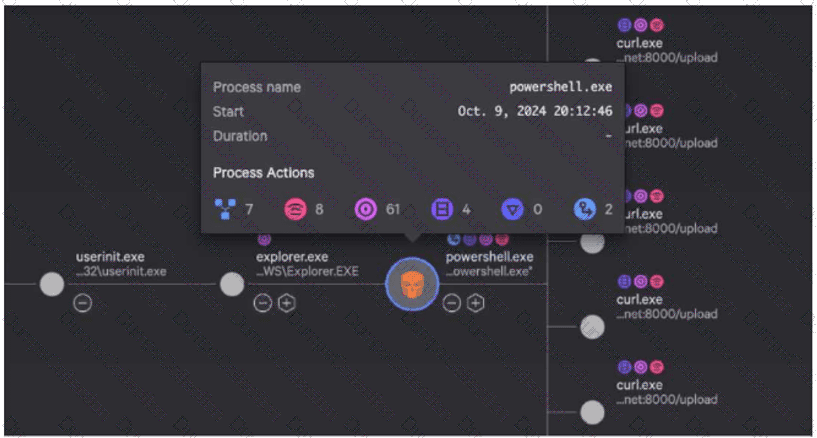
Refer to the exhibit.

While investigating a process tree, you hover over a malicious powershell.exe process. What is the correct sequence of Process Actions?

A.

7 Network Operations, 4 Disk Operations, 8 DNS Requests, 61 Process Operations

B.

8 Network Operations, 61 Disk Operations, 4 DNS Requests, 2 Process Operations

C.

7 Network Operations, 4 Disk Operations, 61 DNS Requests, 2 Process Operations

D.

7 Network Operations, 4 Disk Operations, 61 DNS Requests, 8 Process Operations

Question # 4

Which hunting query's results could indicate that an adversary is performing reconnaissance from a specific host?

A.

#event_simpleName=ProcessRollup2 | aid=?aid | ImageFileName=/ (? < FileName > [^\\\/]*)$ / | FileName=/^(explorer|lsass|svchost|smss|winlogon|userinit)\.exe$/i | table([aid, UserName, ParentBaseFileName, ImageFileName, CommandLine] , limit=1000)

B.

#event_simpleName=NetworkScanEvent | aid=?aid | !cidr(RemoteAddressIP4, subnet=["224.0.0.0/4", "10.0.0.0/8", "172.16.0.0/12", "192.168.0.0/16", "127.0.0.0/8", "169.254.0.0/16", "0.0.0.0/32"]) | table([aid, UserName, ParentBaseFileName, ImageFileName, CommandLine] , limit=1000)

C.

#event_simpleName=NetworkConnect* | RemotePort=?RemotePort aid=?aid | !cidr(RemoteAddressIP4, subnet=["224.0.0.0/4", "10.0.0.0/8", "172.16.0.0/12", "192.168.0.0/16", "127.0.0.0/8", "169.254.0.0/16", "0.0.0.0/32"]) | table([aid, LocalAddressIP4, LocalPort, RemoteAddressIP4, RemotePort] , limit=1000)

D.

#event_simpleName=ProcessRollup2 | aid=?aid | ImageFileName=/ (? < FileName > [^\\\/]*)$ / | FileName=/^(net|ipconfig|whoami|quser|ping|netstat|tasklist|hostname|at)\.exe$/i | table([aid, UserName, ParentBaseFileName, ImageFileName, CommandLine] , limit=1000)

Question # 5

Refer to the image. Which query will show file execution from a suspicious directory across all hosts?

A.

#event_simpleName=ProcessRollup2 | aid=* | ImageFileName=/\\Users\\[^\\]+\\Desktop\\/i | groupBy(aid, function=collect([SHA256HashData, ImageFileName] ), limit-max)

B.

#event_simpleName=ProcessRollup2 | aid=c28082797f7f4d81b3f869dbaf6eb712 | ImageFileName=/\$Recycle\.Bin/i | groupBy(aid, function=collect([SHA256HashData, ImageFileName]), limit-max)

C.

#event_simpleName=ProcessRollup2 | aid=* | ImageFileName=/\$Recycle\.Bin/i | groupBy(aid, function=collect([SHA256HashData, ImageFileName]), limit-max)

D.

#event_simpleName=ProcessRollup2 | aid=* | ImageFileName=/\\Users\\[^\\]+\\Downloads\\/i | groupBy(aid, function=collect([SHA256HashData, ImageFileName] ), limit-max)

Question # 6

Your organization has identified a malicious Scheduled task that executes every 5 minutes. Which LogScale event search function can be used to quickly identify and display the unique hosts affected by the malware?

A.

stats

B.

table()

C.

groupBy()

D.

uniq

Question # 7

What is the expected result of this CQL query?

#event_simpleName=UserLogon RemoteAddressIP4=* | !cidr(RemoteAddressIP4, subnet=["224.0.0.0/4", "10.0.0.0/8", "172.16.0.0/12", "192.168.0.0/16", "127.0.0.0/8", "169.254.0.0/16", "0.0.0.0/32"]) | ipLocation(field=RemoteAddressIP4, as="ip")

A.

All remote user network connection events from external IP addresses

B.

All remote user network connection events from internal IP addresses

C.

All user logons originating from internal IP addresses

D.

All user logons originating from external IP addresses

Question # 8

Which field in a DNS Request event points to the responsible process?

A.

ContextProcessld_readable

B.

TargetProcessld_decimal

C.

ContextProcessld_decimal

D.

ParentProcessId_decimal

Question # 9

When will the ContextProcessId be the same value as the TargetProcessId?

A.

When a process spawns a child process, the child process ID matches the TargetProcessId and the ContextProcessId of the parent

B.

When a process spawns a child process, the ContextProcessId of the child will match the TargetProcessId of the parent

C.

When a process is suspended, the TargetProcessId will match the ContextProcessId

D.

When a process terminates, the ContextProcessId will match the TargetProcessId

Question # 10

Where can you find details about key data fields to use in an advanced search query?

A.

In the Crowdstrike Open Source Events Reference

B.

In the Lookup Files section

C.

Via the Falcon console docs

D.

Via the Support Portal

Page: 1 / 2
Total 18 questions

Most Popular Certification Exams

Payment


Contact us

Site Secure

mcafee secure

TESTED 20 Apr 2026