Spring Special Sale - 70% Discount Offer - Ends in 0d 00h 00m 00s - Coupon code: best70

Page: 1 / 1
Total 10 questions
Exam Code: NSE5_SSE_AD-7.6                Update: Mar 15, 2026
Exam Name: Fortinet NSE 5 - FortiSASE and SD-WAN 7.6 Core Administrator

Fortinet Fortinet NSE 5 - FortiSASE and SD-WAN 7.6 Core Administrator NSE5_SSE_AD-7.6 Exam Dumps: Updated Questions & Answers (March 2026)

Question # 1

You have a FortiGate configuration with three user-defined SD-WAN zones and one or two members in each of these zones. One SD-WAN member is no longer used in health-check and SD-WAN rules. This member is the only member of its zone. You want to delete it.

What happens if you delete the SD-WAN member from the FortiGate GUI?

A.

FortiGate displays an error message. SD-WAN zones must contain at least one member.

B.

FortiGate accepts the deletion and removes static routes as required.

C.

FortiGate accepts the deletion with no further action.

D.

FortiGate accepts the deletion and places the member in the default SD-WAN zone.

Question # 2

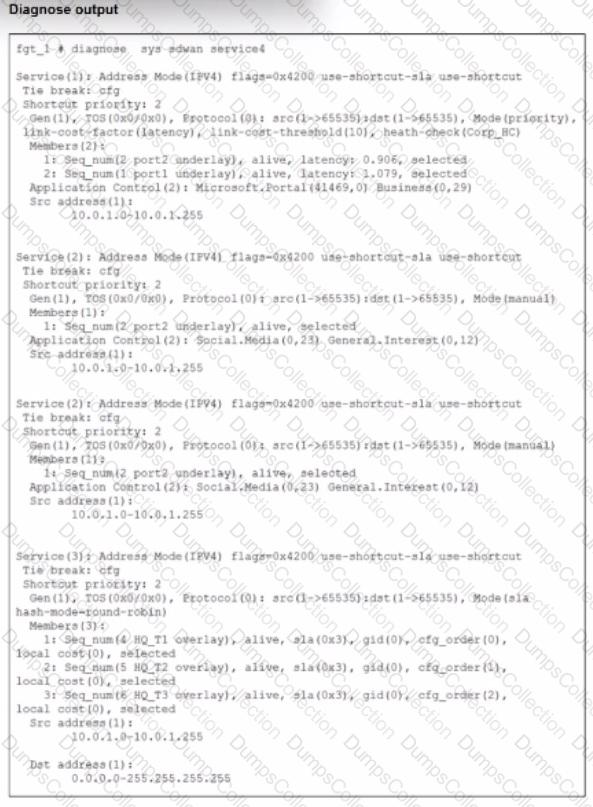
Refer to the exhibit.

The exhibit shows output of the command diagnose sys sdwan service collected on a FortiGate device.

The administrator wants to know through which interface FortiGate will steer traffic from local users on subnet 10.0.1.0/255.255.255.192 and with a destination of the social media application Facebook.

Based on the exhibits, which two statements are correct? (Choose two.)

A.

FortiGate steers traffic for social media applications according to the service rule 2 and steers traffic through port2.

B.

There is no service defined for the Facebook application, so FortiGate applies service rule 3 and directs the traffic to headquarters.

C.

When FortiGate cannot recognize the application of the flow, it load balances the traffic through the tunnels HQ_T1, HQ_T2, HQ_T3.

D.

When FortiGate cannot recognize the application of the flow, it steers the traffic through the preferred member of rule 3, HQ_T1.

Question # 3

Which three authentication sources support secure identity verification and access control for FortiSASE remote users? (Choose three.)

A.

Security Assertion Markup Language (SAML)

B.

OpenID Conned (OIDC)

C.

Lightweight Directory Access Protocol (LDAP)

D.

Terminal Access Controller Access-Control System Plus (TACACS+)

E.

Remote Authentication Dial-in User Service (RADIUS)

Question # 4

Which configuration is a valid use case for FortiSASE features in supporting remote users?

A.

Enabling secure SaaS access through SD-WAN integration, protecting against web-based threats with data loss prevention, and monitoring user connectivity with shadow IT visibility.

B.

Monitoring SaaS application performance, isolating browser sessions for all websites, and integrating with SD-WAN for data loss prevention.

C.

Enabling secure web browsing to protect against threats, providing explicit application access with zero-trust or SD-WAN integration, and addressing shadow IT visibility with data loss prevention.

D.

Providing secure web browsing through remote browser isolation, addressing shadow IT with zero-trust access, and protecting data at rest only.

Question # 5

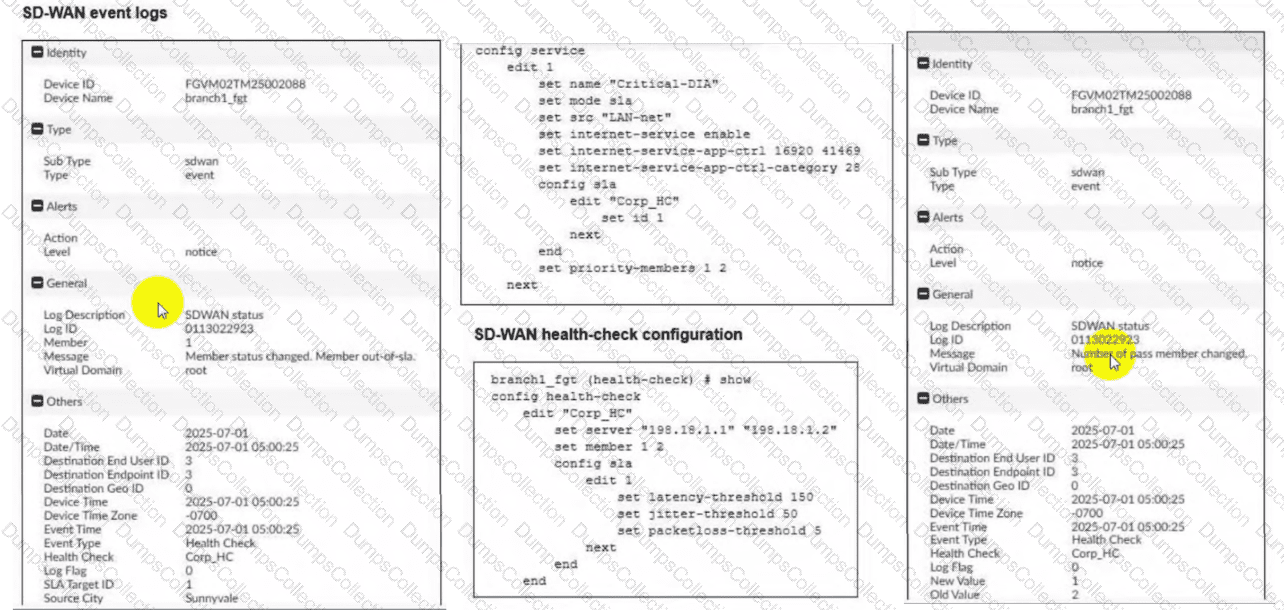
Refer to the exhibits.

Two SD-WAN event logs, the member status, the SD-WAN rule configuration, and the health-check configuration for a FortiGate device are shown. Immediately after the log messages are displayed, how will the FortiGate steer the traffic based on the information shown in the exhibits? (Choose one answer)

A.

FortiGate uses port1 or port2 to steer the traffic for SD-WAN rule ID 1.

B.

FortiGate uses port1 to steer the traffic for SD-WAN rule ID 1.

C.

FortiGate uses port2 to steer the traffic for SD-WAN rule ID 1.

D.

FortiGate skips SD-WAN rule ID 1.

Question # 6

Which two statements correctly describe what happens when traffic matches the implicit SD-WAN rule? (Choose two answers)

A.

Traffic is load balanced using the algorithm set for the v4-ecmp-mode setting.

B.

Traffic does not match any of the entries in the policy route table.

C.

FortiGate flags the session with may_dirty and vwl_default.

D.

The traffic is distributed, regardless of weight, through all available static routes.

E.

The session information output displays no SD-WAN service id.

Question # 7

What is a key use case for FortiSASE Secure Internet Access (SIA) in an agentless deployment? (Choose one answer)

A.

It provides secure web browsing by isolating browser sessions and enforcing data loss prevention for temporary employees.

B.

It acts as a secure web gateway (SWG) distributing a PAC file for explicit web proxy use, securing HTTP and HTTPS traffic with a full security stack, and is ideal for unmanaged endpoints like contractors.

C.

It distributes a PAC file to secure non-web traffic protocols and applies antivirus protection only for managed endpoints.

D.

It requires FortiClient endpoints and supports ZTNA tags to secure all network traffic for unmanaged endpoints.

Question # 8

Which three FortiSASE use cases are possible? (Choose three answers)

A.

Secure Internet Access (SIA)

B.

Secure SaaS Access (SSA)

C.

Secure Private Access (SPA)

D.

Secure VPN Access (SVA)

E.

Secure Browser Access (SBA)

Question # 9

Which statement is true about FortiSASE supported deployment?

A.

FortiSASE supports VPN mode and Agentless mode, based on user requirements.

B.

FortiSASE supports both Endpoint mode and SWG mode, depending on deployment.

C.

FortiSASE operates only in SWG mode, where all traffic is forced through FortiSASE POPs.

D.

FortiSASE relies on ZTNA-only mode, which replaces SWG and endpoint functions.

Question # 10

You want FortiGate to use SD-WAN rules to steer ping local-out traffic. Which two constraints should you consider? (Choose two.)

A.

You must configure each local-out feature individually to use SD-WAN.

B.

By default, FortiGate uses SD-WAN rules only for local-out traffic that corresponds to ping and traceroute.

C.

You can steer local-out traffic only with SD-WAN rules that use the manual strategy.

D.

By default, FortiGate uses SD-WAN rules only for local-out traffic that corresponds to ping and traceroute.

Page: 1 / 1
Total 10 questions

Most Popular Certification Exams

Payment


Contact us

Site Secure

mcafee secure

TESTED 15 Mar 2026