
You are investigating an open incident and want to add records from the Tickets module, a custom module, to the visual correlation widget. Assume there are already linked ticket records to the incident.
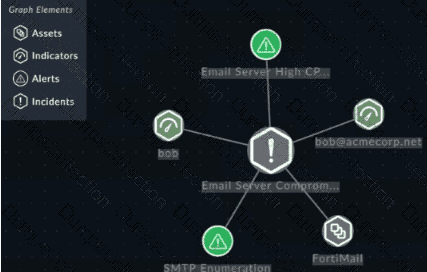
How do you accomplish this? Choose one answer.
A large enterprise FortiSIEM deployment is experiencing delays in log correlation and analytics. Which architectural adjustment is most appropriate? Choose one answer.
Refer to the exhibit.
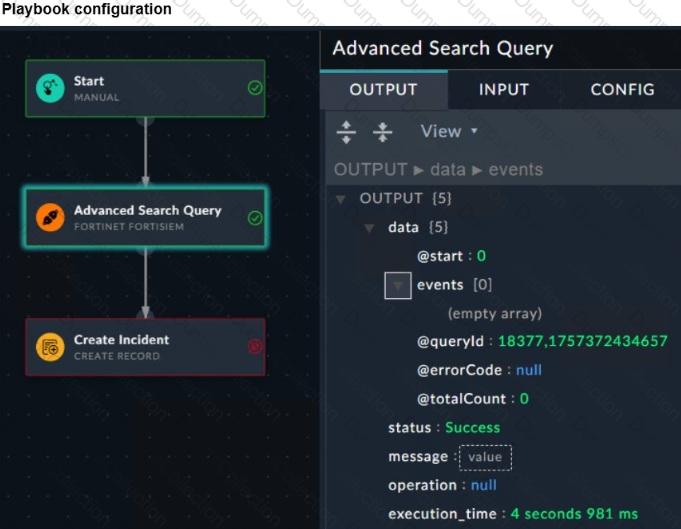
You created a threat hunting playbook to perform a search query using the FortiSIEM connector. However, when you run the playbook, you do not see any output. Which step must you take first in your troubleshooting process?
Refer to the Exhibit:
An analyst wants to create an incident and generate a report whenever FortiAnalyzer generates a malicious attachment event based on FortiSandbox analysis. The endpoint hosts are protected by FortiClient EMS integrated with FortiSandbox. All devices are logging to FortiAnalyzer.
Which connector must the analyst use in this playbook?
You want to use the queue and shift management feature to automatically assign newly created low-priority tasks to members of the L1 queue. However, you are unable to add the Tasks module to the Module Types list. What is the problem? Choose one answer.
Refer to the exhibit.
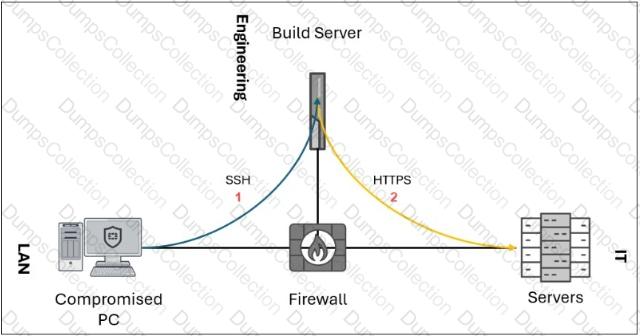
A compromised PC establishes an SSH connection to an engineering build server, which then relays HTTPS traffic to reach servers that would otherwise have blocked access from the LAN. Which technique is used for this attack?
Refer to Exhibit:
You are tasked with reviewing a new FortiAnalyzer deployment in a network with multiple registered logging devices. There is only one FortiAnalyzer in the topology.
Which potential problem do you observe?
You are trying to create a playbook that creates a manual task showing a list of public IPv6 addresses. You were successful in extracting all IP addresses from a previous action into a variable called ip_list, which contains both private and public IPv4 and IPv6 addresses. You must now filter the results to display only public IPv6 addresses. Which two Jinja expressions can accomplish this task? (Choose two answers)
You are designing a FortiSOAR hybrid multi-tenant deployment. The architecture must support remote tenant execution and automation inside segmented networks. Which three elements are true for this design? Choose three answers.
A customer wants FortiAnalyzer to run an automation stitch that executes a CLI command on FortiGate to block a predefined list of URLs, if a botnet command-and-control (C & C) server IP is detected.
Which FortiAnalyzer feature must you use to start this automation process?

TESTED 27 Oct 2026