
Winter Special Limited Time 65% Discount Offer - Ends in 0d 00h 00m 00s - Coupon code: dcdisc65

Page: 1 / 4
Total 34 questions
Exam Code: H13-511_V5.5                Update: Jan 19, 2026
Exam Name: HCIA-Cloud Computing V5.5 Exam

Huawei HCIA-Cloud Computing V5.5 Exam H13-511_V5.5 Exam Dumps: Updated Questions & Answers (January 2026)

Question # 1

Which of the following statements is false about centralized storage and distributed storage?

A.

Distributed storage stores data on multiple independent devices. During data reading, data is read from these devices at the same time, affecting read efficiency.

B.

Centralized storage has a simple deployment structure. It can leverage the redundant array of independent disks (RAID) technology to ensure data security and reliability.

C.

In terms of technical architectures, centralized storage can be classified into network attached storage (NAS) and storage area network (SAN). SANs are further divided into Fibre Channel storage area networks (FC SANs) and IP storage area networks (IP SANs).

D.

Distributed storage adopts a scalable system architecture and enables multiple storage servers to share the storage load, improving scalability, reliability, availability, and access efficiency.

Question # 2

Which of the following FusionAccess componentsdoes not have backup data?

A.

License

B.

WI

C.

VLB

D.

vAG

Question # 3

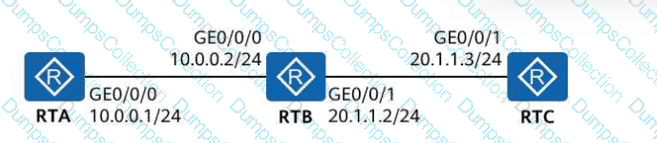
Which of the following statements arefalseabout the network shown in the figure?
A.

The next-hop address of the packet sent from RTA to RTC is20.1.1.2.

B.

If RTA needs to communicate with RTC, a route needs to be configured onRTC.

C.

RTB can communicate with RTA and RTCwithout any configuration modification.

D.

If RTA needs to communicate with RTC, a route needs to be configured onRTB.

Question # 4

Which of the following statements are true about the differences between OpenStack and FusionCompute?

A.

OpenStack is open-source software, and FusionCompute is closed-source commercial software.3

B.

OpenStack does not have any virtualization capability, while FusionCompute can directly pool physical hardware resources.

C.

OpenStack can manage VMs, bare metal servers, and containers, but FusionCompute cannot manage containers.

D.

OpenStack has concepts about projects and tenants, but FusionCompute does not have the concept about tenants.

Question # 5

Which of the following statements about FusionAccess for office automation (OA) isfalse?

A.

FusionAccess can be interconnected with existing enterprise IT systems to use existing IT applications.

B.

FusionAccess has three zones (red, yellow, and green). These zones are isolated from each other and have their own FusionAccess systems. Data can be transmitted between them.

C.

Zone-based security is high, easy to deploy, and meets the security management requirements of most enterprises.

D.

Enterprise Active Directory (AD) is an important component of FusionAccess, and users must be authenticated by AD before logging in to virtual desktops.

Question # 6

Two virtual machines run on the same host and are in the same network segment, but they cannot communicate with each other. Which of the following isnota possible cause?

A.

VM firewalls deny access to each other.

B.

The NICs of the two VMs are added to the same port group.

C.

The VMs are isolated by security groups.

D.

The VM NICs are faulty.

Question # 7

On FusionAccess, when creating afull copy, QuickPrep, or linked clone template, the template must be added to a domain.

A.

TRUE

B.

FALSE

Question # 8

Which of the following are functions of FusionCompute?

A.

Datastores support file system formats VIMS, NFS, and EXT4.

B.

Users can expand or reduce the memory capacity for online or offline VMs as needed.

C.

Storage live migration is to migrate data within a storage device or between different storage devices.

D.

VM live migration only allows VMs to migrate among hosts that share the same storage.

Question # 9

At which layer of the TCP/IP reference model does a router work?

A.

Data link layer

B.

Network layer

C.

Application layer

D.

Transport layer

Question # 10

When deploying vLB, you can usually deploy vAG and vLB on the same VM, but you cannot deploy vLB and WI on the same VM.

A.

TRUE

B.

FALSE

Page: 1 / 4
Total 34 questions

Most Popular Certification Exams

Payment


Contact us

dumpscollection live chat

Site Secure

mcafee secure

TESTED 19 Jan 2026