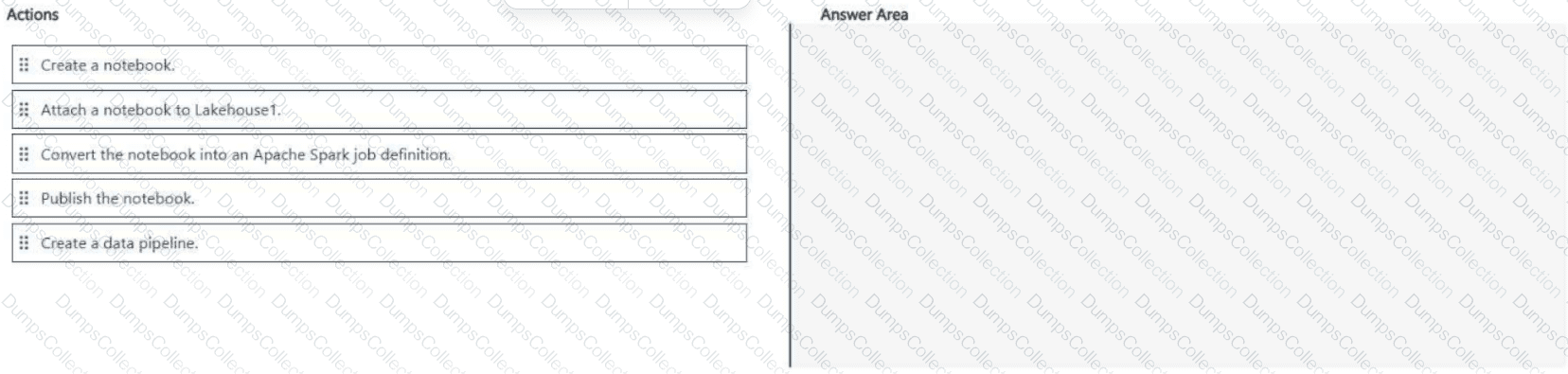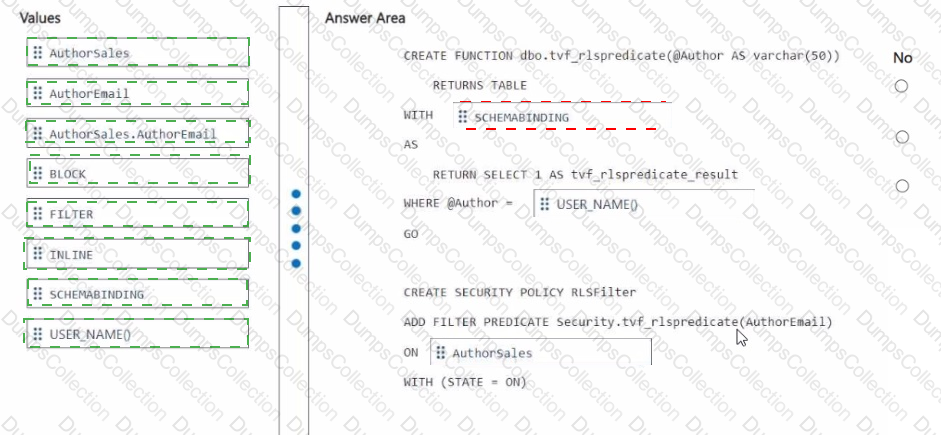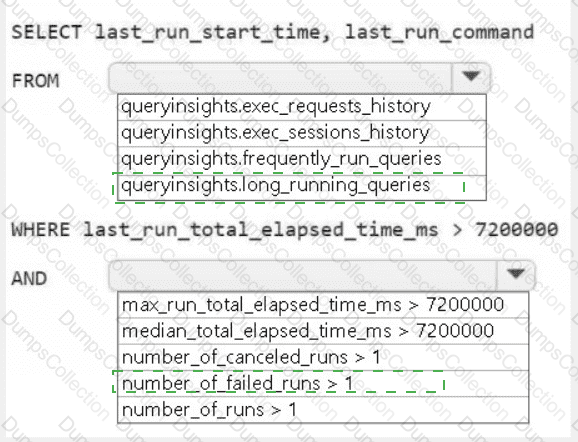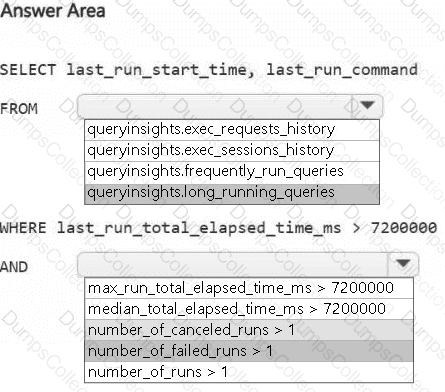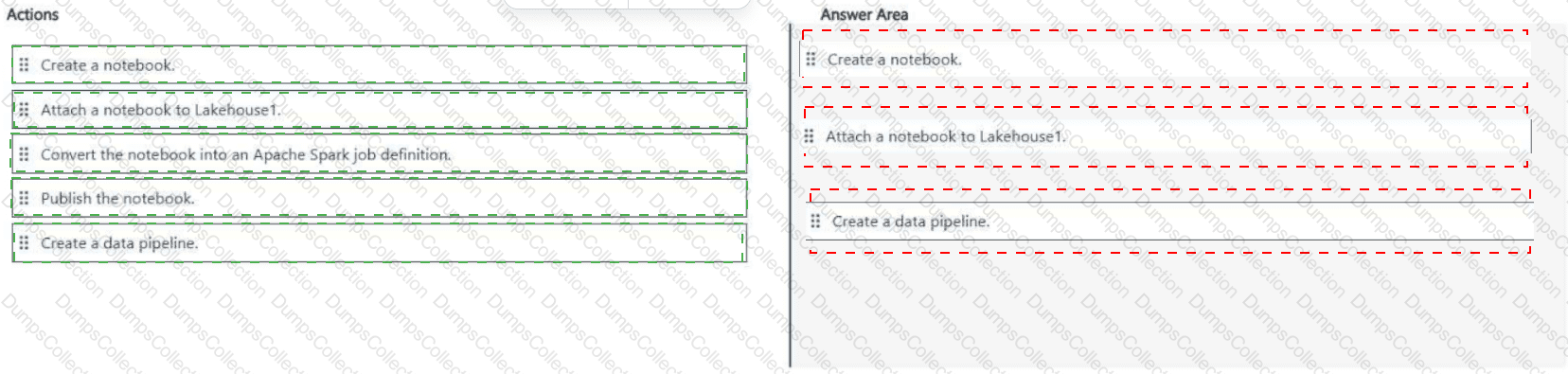
You have a Fabric .
In Warehouse1, you create a table named DimCustomer by running the following statement.

You need to set the Customerkey column as a primary key of the DimCustomer table.
Which three code segments should you run in sequence? To answer, move the appropriate code segments from the list of code segments to the answer area and arrange them in the correct order.

HOTSPOT
You have an Azure Event Hubs data source that contains weather data.
You ingest the data from the data source by using an eventstream named Eventstream1. Eventstream1 uses a lakehouse as the destination.
You need to batch ingest only rows from the data source where the City attribute has a value of Kansas. The filter must be added before the destination. The solution must minimize development effort.
What should you use for the data processor and filtering? To answer, select the appropriate options in the answer area.
NOTE: Each correct selection is worth one point.
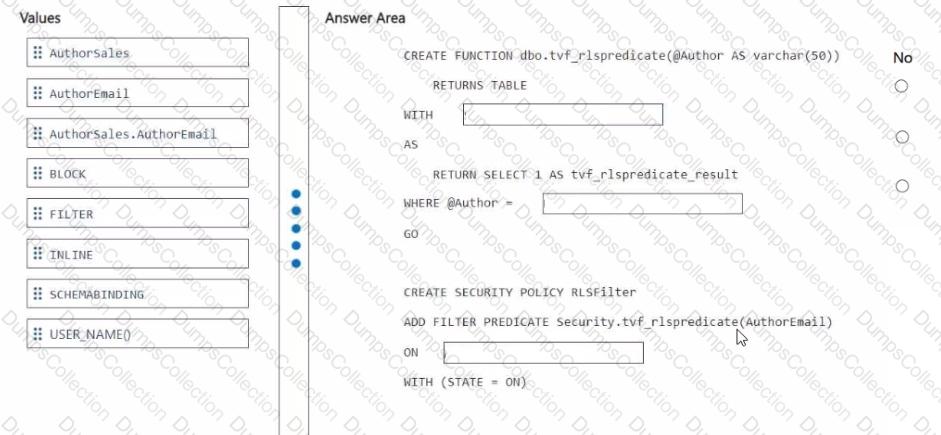
You have a Fabric workspace.
You have semi-structured data.
You need to read the data by using T-SQL, KQL, and Apache Spark. The data will only be written by using Spark.
What should you use to store the data?
Note: This question is part of a series of questions that present the same scenario. Each question in the series contains a unique solution that might meet the stated goals. Some question sets might have more than one correct solution, while others might not have a correct solution.
After you answer a question in this section, you will NOT be able to return to it. As a result, these questions will not appear in the review screen.
You have a Fabric eventstream that loads data into a table named Bike_Location in a KQL database. The table contains the following columns:
BikepointID
Street
Neighbourhood
No_Bikes
No_Empty_Docks
Timestamp
You need to apply transformation and filter logic to prepare the data for consumption. The solution must return data for a neighbourhood named Sands End when No_Bikes is at least 15. The results must be ordered by No_Bikes in ascending order.
Solution: You use the following code segment:

Does this meet the goal?
You have an Azure subscription that contains a blob storage account named sa1. Sa1 contains two files named Filelxsv and File2.csv.
You have a Fabric tenant that contains the items shown in the following table.

You need to configure Pipeline1 to perform the following actions:
• At 2 PM each day, process Filel.csv and load the file into flhl.
• At 5 PM each day. process File2.csv and load the file into flhl.
The solution must minimize development effort. What should you use?
Note: This question is part of a series of questions that present the same scenario. Each question in the series contains a unique solution that might meet the stated goals. Some question sets might have more than one correct solution, while others might not have a correct solution.
After you answer a question in this section, you will NOT be able to return to it. As a result, these questions will not appear in the review screen.
You have a Fabric eventstream that loads data into a table named Bike_Location in a KQL database. The table contains the following columns:
BikepointID
Street
Neighbourhood
No_Bikes
No_Empty_Docks
Timestamp
You need to apply transformation and filter logic to prepare the data for consumption. The solution must return data for a neighbourhood named Sands End when No_Bikes is at least 15. The results must be ordered by No_Bikes in ascending order.
Solution: You use the following code segment:

Does this meet the goal?
HOTSPOT
You have a Fabric workspace that contains a warehouse named DW1. DW1 contains the following tables and columns.

You need to create an output that presents the summarized values of all the order quantities by year and product. The results must include a summary of the order quantities at the year level for all the products.
How should you complete the code? To answer, select the appropriate options in the answer area.
NOTE: Each correct selection is worth one point.
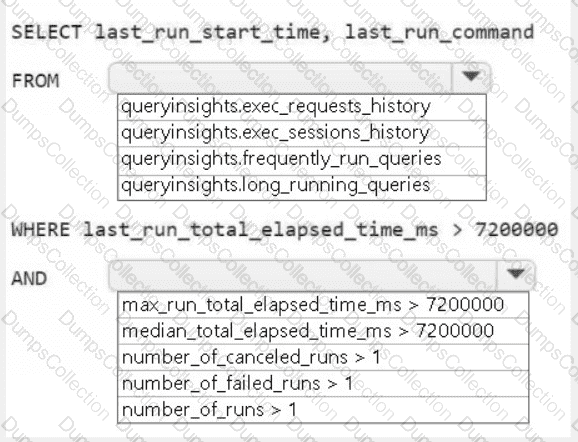
You have a Fabric data warehouse that contains the following tables.

You need to refresh the tables by using an automated pipeline. The solution must ensure that table updates occur in the correct order to maintain referential integrity.
Which two tables should you refresh first? Each correct answer presents part of the solution.
NOTE: Each correct selection is worth one point.
You have a Fabric F32 capacity that contains a workspace. The workspace contains a warehouse named DW1 that is modelled by using MD5 hash surrogate keys.
DW1 contains a single fact table that has grown from 200 million rows to 500 million rows during the past year.
You have Microsoft Power BI reports that are based on Direct Lake. The reports show year-over-year values.
Users report that the performance of some of the reports has degraded over time and some visuals show errors.
You need to resolve the performance issues. The solution must meet the following requirements:
Provide the best query performance.
Minimize operational costs.
Which should you do?
You have a Fabric workspace that contains an eventstream named EventStreaml. EventStreaml outputs events to a table named Tablel in a lakehouse. The streaming data is souiced from motorway sensors and represents the speed of cars.
You need to add a transformation to EventStream1 to average the car speeds. The speeds must be grouped by non-overlapping and contiguous time intervals of one minute. Each event must belong to exactly one window.
Which windowing function should you use?
TESTED 18 Jul 2026