Black Friday Power Hour Limited Time 80% Discount Offer - Ends in 0d 00h 00m 00s - Coupon code: best80

Page: 1 / 5
Total 45 questions
Exam Code: GH-200                Update: Nov 27, 2026
Exam Name: GitHub Actions Exam

Microsoft GitHub Actions Exam GH-200 Exam Dumps: Updated Questions & Answers (November 2026)

Question # 1

As a developer, what options should you recommend to implement standards for automation reuse? (Choose two.)

A.

Create workflow templates and store them in the organization ' s .github repository.

B.

Create reusable actions and workflows that can be called from other workflows.

C.

Create a marketplace partition to publish reusable automation for the company.

D.

Store shared corporate actions in subfolders in a defined and documented internally accessible repository.

Question # 2

You are a DevOps engineer working on custom Actions development. You need to handle errors or exceptions as part of the JavaScript-based action code. What should be added to the following code block to handle errors?

const core = require( ' @actions/core ' );

try {

// action code

} catch (error) {

// insert snippet here

}

A.

core.setException(error.message);

B.

core.action.setException(error.message);

C.

core.setFailed(error.message);

D.

action.setError(error.message);

Question # 3

How many jobs will result from the following matrix configuration?

A.

3 jobs

B.

4 jobs

C.

5 jobs

D.

6 jobs

Question # 4

As a developer, you are optimizing a GitHub workflow that uses and produces many different files. You need to determine when to use caching versus workflow artifacts. Which two statements are true? (Choose two.)

A.

Use caching when reusing files that change rarely between jobs or workflow runs.

B.

Use artifacts when referencing files produced by a job after a workflow has ended.

C.

Use caching to store cache entries for up to 30 days between accesses.

D.

Use artifacts to access the GitHub Package Registry and download a package for a workflow

Question # 5

Which of the following scenarios would require the use of self-hosted runners instead of GitHub-hosted runners?

A.

running more than the three concurrent workflows supported by GitHub-hosted runners

B.

exceeding 50,000 monthly minutes of build time

C.

using Docker containers as part of the workflow

D.

using specialized hardware configurations required for workflows

E.

performing builds on macOS

Question # 6

What is the simplest action type to run a shell script?

A.

Docker container action

B.

Composite action

C.

Bash script action

D.

JavaScript action

Question # 7

Which two actions ensure that a GitHub Actions workflow can be triggered manually? Each correct answer presents a complete solution.

NOTE: Each correct selection is worth one point.

A.

Define a workflow_dispatch event and specify inputs that enable users to provide values when triggering the workflow manually.

B.

Use a schedule event and add a manual: false parameter.

C.

Define a workflow_dispatch event in the on field of the workflow YAML file.

D.

Trigger a workflow manually by using a workflow_call event that has a button on the UI.

Question # 8

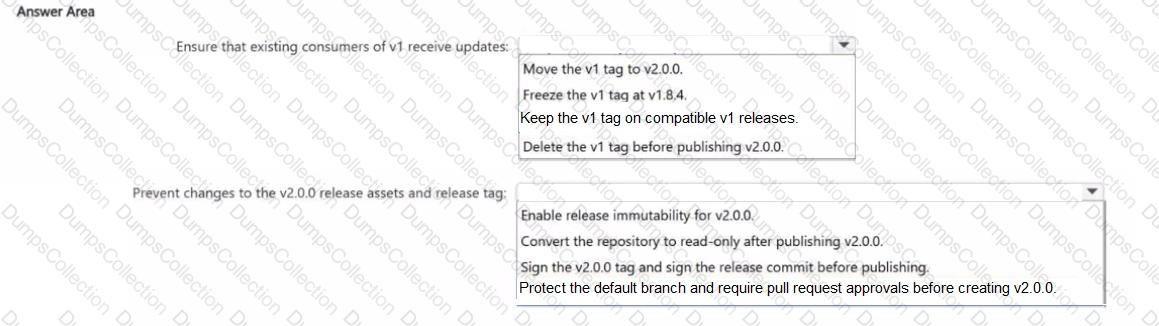
You have a GitHub Enterprise Server instance that hosts a custom action repository named action1. Production workflows use the actions in action1 as action1@vl. The current stable release of action1 is vl.8.4.

You need to publish a new release of action1 with version number v2.0.0 that changes an input name and includes release assets. The solution must meet the following requirements:

• Ensure that existing consumers of v1 continue to receive backward-compatible updates.

• Prevent changes to the published V2.0.0 release assets and release tag after publication.

What should you do for each requirement? To answer, select the appropriate options in the answer area.

NOTE: Each correct selection is worth one point.
Question # 9

As a developer, you need to use GitHub Actions to deploy a microservice that requires runtime access to a secure token. This token is used by a variety of other microservices managed by different teams in different repos. To minimize management overhead and ensure the token is secure, which mechanisms should you use to store and access the token? (Choose two.)

A.

Store the token in a configuration file in a private repository. Use GitHub Actions to deploy the configuration file to the runtime environment.

B.

Store the token as a GitHub encrypted secret in the same repo as the code. Create a reusable custom GitHub Action to access the token by the microservice at runtime.

C.

Use a corporate non-GitHub secret store (e.g., HashiCorp Vault) to store the token. During deployment, use GitHub Actions to store the secret in an environment variable that can be accessed at runtime.

D.

Store the token as a GitHub encrypted secret in the same repo as the code. During deployment, use GitHub Actions to store the secret in an environment variable that can be accessed at runtime.

E.

Store the token as an organizational-level encrypted secret in GitHub. During deployment, use GitHub Actions to store the secret in an environment variable that can be accessed at runtime.

Question # 10

As a developer, you are configuring GitHub Actions to deploy VMs to production. A member of the VMOps team must provide approval before the deployment occurs. Which two steps should you take? Each correct answer presents part of the solution.

NOTE: Each correct answer is worth one point.

A.

Navigate to the repository settings and create a Production environment with the VMOps team as a required reviewer.

B.

Navigate to the organization settings and create a Production environment with the VMOps team as a required reviewer.

C.

Specify the VMOps team as the owner of the environment.

D.

Specify the environment named Production in the workflow jobs that deploy to the VMs.

E.

Add the VMs to the environment.

Page: 1 / 5
Total 45 questions

Most Popular Certification Exams

Payment


Contact us

Site Secure

mcafee secure

TESTED 27 Nov 2026