
Recently, several new VMs were deployed as part of an application expansion. Within 24 hours, the administrator notices no recovery points are being created for the new VMs.
During investigation, the administrator observes:
Existing VMs in the Protection Policy continue to replicate successfully.
No replication task failures are reported.
Network connectivity between clusters is healthy.
Storage capacity at the remote site is sufficient.
The Protection Policy uses category-based entity selection.
The newly deployed VMs were provisioned by a separate team.
What is the most likely root cause of the issue?
What must the maximum Round Trip Latency be less than between a Witness VM and Metro Availability PDs?
An organization uses a Recovery Plan to protect a SQL Cluster that relies on Volume Groups (VGs). The VGs are configured with hypervisor attachments. The administrator executes a Planned Failover to migrate the SQL Cluster to the Recovery Site. The Failover task completes successfully, but the database administrators report that the database is offline. What is the possible cause of this issue?
An administrator executes an Unplanned Failover of web server VMs from an on-premises AZ to a Nutanix Cloud Cluster (NC2) on AWS. The Recovery Plan completes, and the VMs are running. However, external users cannot access the websites hosted on these VMs. The administrator verifies that the firewall rules are set correctly. What specific configuration is required for these VMs to be reachable from the external network after failover to NC2?
An administrator plans to configure Cross Hypervisor Disaster Recovery (CHDR) to replicate VMs from an ESXi cluster to an AHV cluster using an Asynchronous replication schedule. Which component must be installed on the VMs to ensure successful migration and driver configuration during recovery?
During the Recovery Plan configuration, the administrator maps the " Test Network " setting to the " Production Network " VLAN on the Recovery Site. What is the expected outcome when the administrator executes a Test Failover for this plan?
An administrator has set up asynchronous replication between the Marseille and Paris clusters for the VMs in the FIN-PROD storage container. After a planned production failover from Paris to Marseille, the administrator noticed that the VMs were scattered across all the storage containers in the Marseille cluster. Which statement is true regarding this scenario?
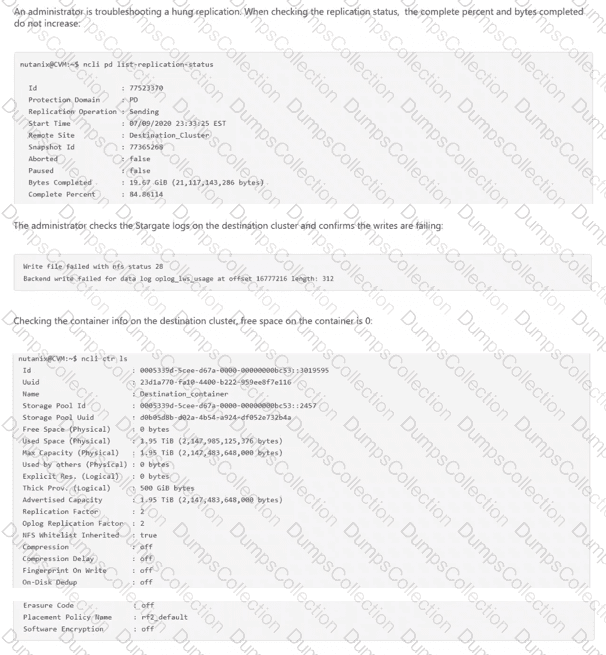
An administrator is troubleshooting a hung replication. When checking the replication status, the complete percent and bytes completed do not increase. The administrator checks the Stargate logs on the destination cluster and confirms the writes are failing with " nfs status 28 " . Checking the container info on the destination cluster, free space on the container is 0. The administrator confirms that there is sufficient space available in the storage pool. What could be the reason for free space on the container to be 0?
An administrator initiates an unplanned failover due to a primary AZ outage. What is the worst-case scenario for data loss and which recovery point will be used by default?
During routine monitoring, an administrator notices that replication from the primary Nutanix cluster to the recovery cluster has stopped. New recovery points are not being created, and the DR dashboard shows replication errors. Investigation reveals:
The primary and recovery clusters are both online and healthy.
Network segmentation was recently enabled to isolate replication traffic from other workloads.
No recent changes were made to firewall rules, protection policies or RPO settings.
Which action should the administrator take first to investigate the replication failure?

TESTED 16 Oct 2026