Scenario 3: NightCore is a multinational technology company based in the United States that focuses on e-commerce, cloud computing, digital streaming, and artificial intelligence. After having an information security management system (ISMS) implemented for over 8 months, they contracted a certification body to conduct a third party audit in order to get certified against ISO/IEC 27001.
The certification body set up a team of seven auditors. Jack, the most experienced auditor, was assigned as the audit team leader. Over the years, he received many well known certifications, such as the ISO/IEC 27001 Lead Auditor, CISA, CISSP, and CISM.
Jack conducted thorough analyses on each phase of the ISMS audit, by studying and evaluating every information security requirement and control that was implemented by NightCore. During stage 2 audit. Jack detected several nonconformities. After comparing the number of purchased invoices for software licenses with the software inventory, Jack found out that the company has been using the illegal versions of a software for many computers. He decided to ask for an explanation from the top management about this nonconformity and see whether they were aware about this. His next step was to audit NightCore's IT Department. The top management assigned Tom, NightCore's system administrator, to act as a guide and accompany Jack and the audit team toward the inner workings of their system and their digital assets infrastructure.
While interviewing a member of the Department of Finance, the auditors discovered that the company had recently made some unusual large transactions to one of their consultants. After gathering all the necessary details regarding the transactions. Jack decided to directly interview the top management.
When discussing about the first nonconformity, the top management told Jack that they willingly decided to use a copied software over the original one since it was cheaper. Jack explained to the top management of NightCore that using illegal versions of software is against the requirements of ISO/IEC 27001 and the national laws and regulations. However, they seemed to be fine with it.
Several months after the audit, Jack sold some of NightCore's information that he collected during the audit for a huge amount of money to competitors of NightCore.
Based on this scenario, answer the following question:
Does ISO/IEC 27001 require organizations to comply with national laws and regulations?
Scenario 4: Branding is a marketing company that works with some of the most famous companies in the US. To reduce internal costs. Branding has outsourced the software development and IT helpdesk operations to Techvology for over two years. Techvology. equipped with the necessary expertise, manages Branding's software, network, and hardware needs. Branding has implemented an information security management system (ISMS) and is certified against ISO/IEC 27001, demonstrating its commitment to maintaining high standards of information security. It actively conducts audits on Techvology to ensure that the security of its outsourced operations complies with ISO/IEC 27001 certification requirements.
During the last audit. Branding's audit team defined the processes to be audited and the audit schedule. They adopted an evidence based approach, particularly in light of two information security incidents reported by Techvology in the past year The focus was on evaluating how these incidents were addressed and ensuring compliance with the terms of the outsourcing agreement
The audit began with a comprehensive review of Techvology's methods for monitoring the quality of outsourced operations, assessing whether the services provided met Branding's expectations and agreed-upon standards The auditors also verified whether Techvology complied with the contractual requirements established between the two entities This involved thoroughly examining the terms and conditions in the outsourcing agreement to guarantee that all aspects, including information security measures, are being adhered to.
Furthermore, the audit included a critical evaluation of the governance processes Techvology uses to manage its outsourced operations and other organizations. This step is crucial for Branding to verify that proper controls and oversight mechanisms are in place to mitigate potential risks associated with the outsourcing arrangement.
The auditors conducted interviews with various levels of Techvology's personnel and analyzed the incident resolution records. In addition, Techvology provided the records that served as evidence that they conducted awareness sessions for the staff regarding incident management. Based on the information gathered, they predicted that both information security incidents were caused by incompetent personnel. Therefore, auditors requested to see the personnel files of the employees involved in the incidents to review evidence of their competence, such as relevant experience, certificates, and records of attended trainings.
Branding's auditors performed a critical evaluation of the validity of the evidence obtained and remained alert for evidence that could contradict or question the reliability of the documented information received. During the audit at Techvology, the auditors upheld this approach by critically assessing the incident resolution records and conducting thorough interviews with employees at different levels and functions. They did not merely take the word of Techvology's representatives for facts; instead, they sought concrete evidence to support the representatives' claims about the incident management processes.
Based on the scenario above, answer the following question:
Question:
According to Scenario 4, what type of audit evidence did the auditors collect to determine the source of the information security incidents?
Question
A security analyst is performing a penetration test on an organization’s internal network. A vulnerability scanning tool detects a high-risk vulnerability in a critical server, suggesting it could allow remote code execution. However, the penetration tester is unable to exploit the vulnerability successfully due to unknown system configurations and patch levels.
Should the company immediately consider this vulnerability as a confirmed security risk?
Scenario 8: EsBank provides banking and financial solutions to the Estonian banking sector since September 2010. The company has a network of 30 branches with over 100 ATMs across the country.
Operating in a highly regulated industry, EsBank must comply with many laws and regulations regarding the security and privacy of data. They need to manage information security across their operations by implementing technical and nontechnical controls. EsBank decided to implement an ISMS based on ISO/IEC 27001 because it provided better security, more risk control, and compliance with key requirements of laws and regulations.
Nine months after the successful implementation of the ISMS, EsBank decided to pursue certification of their ISMS by an independent certification body against ISO/IEC 27001 .The certification audit included all of EsBank’s systems, processes, and technologies.
The stage 1 and stage 2 audits were conducted jointly and several nonconformities were detected. The first nonconformity was related to EsBank’s labeling of information. The company had an information classification scheme but there was no information labeling procedure. As a result, documents requiring the same level of protection would be labeled differently (sometimes as confidential, other times sensitive).
Considering that all the documents were also stored electronically, the nonconformity also impacted media handling. The audit team used sampling and concluded that 50 of 200 removable media stored sensitive information mistakenly classified as confidential. According to the information classification scheme, confidential information is allowed to be stored in removable media, whereas storing sensitive information is strictly prohibited. This marked the other nonconformity.
They drafted the nonconformity report and discussed the audit conclusions with EsBank’s representatives, who agreed to submit an action plan for the detected nonconformities within two months.
EsBank accepted the audit team leader's proposed solution. They resolved the nonconformities by drafting a procedure for information labeling based on the classification scheme for both physical and electronic formats. The removable media procedure was also updated based on this procedure.
Two weeks after the audit completion, EsBank submitted a general action plan. There, they addressed the detected nonconformities and the corrective actions taken, but did not include any details on systems, controls, or operations impacted. The audit team evaluated the action plan and concluded that it would resolve the nonconformities. Yet, EsBank received an unfavorable recommendation for certification.
Based on the scenario above, answer the following question:
Which action illustrated in scenario 8 is unacceptable in an external audit?
Scenario:
After an information security incident, an organization created a comprehensive backup procedure involving regular, automated backups of all critical data to offsite storage locations. By doing so, which principle of information security is the organization applying in this case?
Select the option which best describes how Information Security Management System audits should be conducted:
Scenario 1: Fintive is a distinguished security provider for online payments and protection solutions. Founded in 1999 by Thomas Fin in San Jose, California, Fintive
offers services to companies that operate online and want to improve their information security, prevent fraud, and protect user information such as PII. Fintive centers
its decision-making and operating process based on previous cases. They gather customer data, classify them depending on the case, and analyze them. The company
needed a large number of employees to be able to conduct such complex analyses. After some years, however, the technology that assists in conducting such analyses
advanced as well. Now, Fintive is planning on using a modern tool, a chatbot, to achieve pattern analyses toward preventing fraud in real-time. This tool would also be
used to assist in improving customer service.
This initial idea was communicated to the software development team, who supported it and were assigned to work on this project. They began integrating the chatbot
on their existing system. In addition, the team set an objective regarding the chatbot which was to answer 85% of all chat queries.
After the successful integration of the chatbot, the company immediately released it to their customers for use. The chatbot, however, appeared to have some issues.
Due to insufficient testing and lack of samples provided to the chatbot during the training phase, in which it was supposed "to learn" the queries pattern, the chatbot
failed to address user queries and provide the right answers. Furthermore, the chatbot sent random files to users when it received invalid inputs such as odd patterns
of dots and special characters. Therefore, the chatbot was unable to properly answer customer queries and the traditional customer support was overwhelmed with
chat queries and thus was unable to help customers with their requests.
Consequently, Fintive established a software development policy. This policy specified that whether the software is developed in-house or outsourced, it will undergo a
black box testing prior to its implementation on operational systems.
According to scenario 1, the chatbot sent random files to users when it received invalid inputs. What impact might that lead to?
You ask the IT Manager why the organisation still uses the mobile app while personal data
encryption and pseudonymization tests failed. Also, whether the Service Manager is authorized to approve the test.
The IT Manager explains the test results should be approved by him according to the software security management procedure. The reason why the encryption and pseudonymization functions failed is that these functions heavily slowed down the system and service performance. An extra 150% of resources are needed to cover this. The Service Manager agreed that access control is good enough and acceptable. That's why the Service Manager signed the approval.
You sample one of the medical staff's mobile and found that ABC's healthcare mobile app, version 1.01 is installed. You found that version 1.01 has no test record.
The IT Manager explains that because of frequent ransomware attacks, the outsourced mobile app development company gave a free minor update on the tested software, performed an emergency release of the updated software, and gave a verbal guarantee that there will be no impact on any security functions. Based on his 20 years of information security experience, there is no need to re-test.
You are preparing the audit findings Select two options that are correct.
There is NO nonconformity (NC). The IT Manager demonstrates he is fully competent. (Relevant to clause 7.2)
Question:
An organization is evaluating the materiality of different processes within its ISMS. It is assessing the direct expenses involved with personnel, third-party services, and general fees. Which factor of materiality is the company primarily considering?
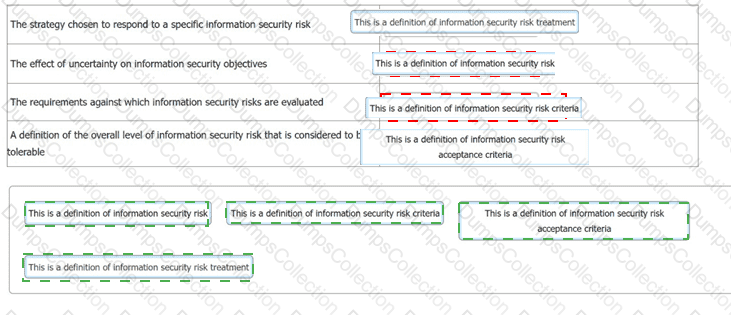
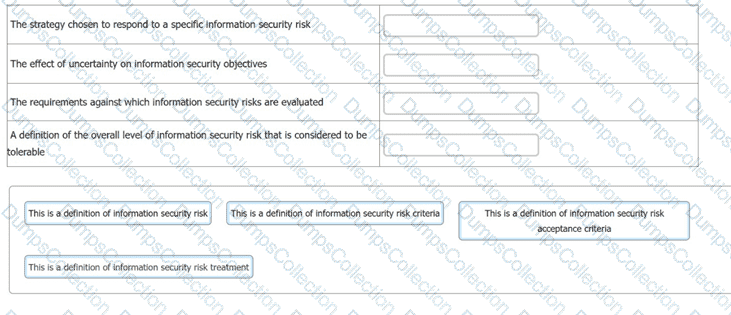
You have just completed a scheduled information security audit of your organisation when the IT Manager approaches you and asks for your assistance in the revision of the company's risk management process.
He is attempting to update the current documentation to make it easier for other managers to understand, however, it is clear from your discussion he is confusing several key terms.
You ask him to match each of the descriptions with the appropriate risk term. What should the correct answers be?

TESTED 08 Oct 2026