
An administrator has been tasked with deploying vSAN Data Protection in a VMware Cloud Foundation (VCF) Workload Domain. The administrator deploys the VMware Live Recovery OVA and logs into the management interface to start the Configure Appliance process, but the appliance fails to register with vCenter.
What are two possible causes the administrator can check to resolve the issue? (Choose two.)
An agency is designing its secure private cloud on VMware Cloud Foundation with the following requirements:
• Strict data segregation between the management and workload domains.
• Company policy prevents using vSAN as a storage solution.
• Data encryption at rest is mandatory for both the management and workload domains.
• Data encryption in transit is mandatory for the workload domains.
• Data-at-rest encryption must be performed by the storage array and not rely on VMware native or vSAN-specific mechanisms.
• Allow for automated VM placement, operational integrity with VCF Operations, and assurance that file-based workloads scale efficiently.
Which storage architecture fulfills these technical and regulatory requirements?
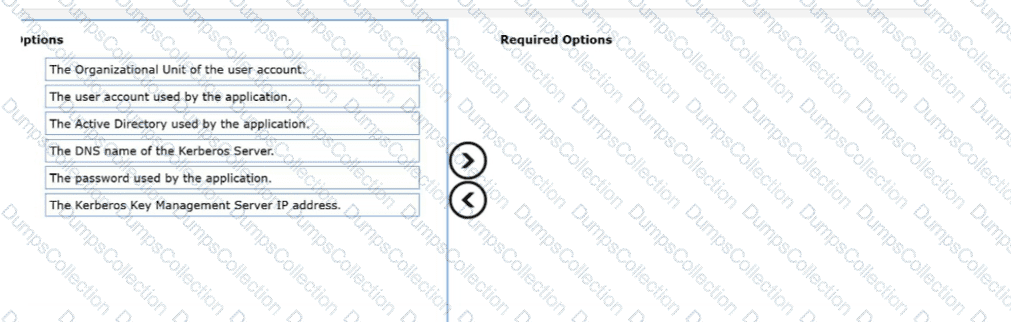
An administrator has been presented with the following requirements from an application owner:
• The application is distributed across multiple data centers.
• The application currently uses NFSv4.1 for mounting data volumes.
• The application requires Kerberos encryption.
Drag and drop the three correct options from the Options list on the left and place them into the Required Options on the right to properly configure the storage solution to meet the requirements in any order. (Choose three.)
While creating a recovery plan that matches the business continuity plan, an administrator needs to add custom steps to the recovery plan.
Which three custom steps are available? (Choose three.)
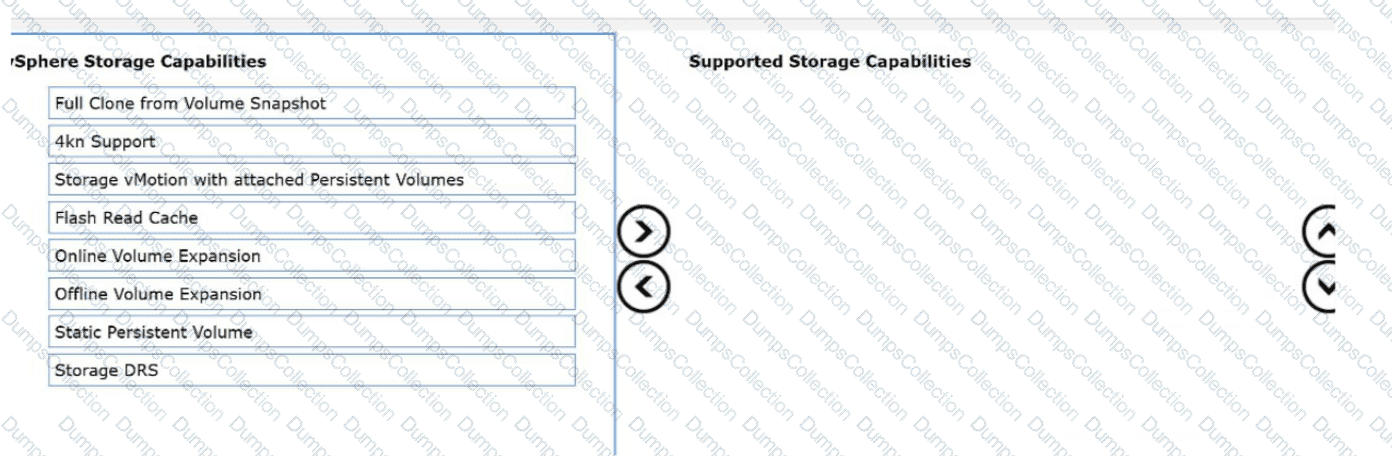
Select the storage capabilities supported for use with persistent volumes in the VMware Kubernetes Service (VKS) in VMware Cloud Foundation (VCF).
Drag and drop the five supported capabilities from the vSphere Storage Capabilities list on the left and place them into the Supported Storage Capabilities list on the right in any order. (Choose five.)
An administrator is troubleshooting a vSAN performance issue. In the vSAN cluster performance charts there is a high latency on the vSAN cluster.
What is a possible cause of the performance issue?
An administrator is managing a stretched vSAN ESA cluster where each site has three hosts.
The following parameters apply to the storage policy being configured at the datastore level:
• The policy is configured at the datastore level
• Site disaster tolerance = Site mirroring - stretched cluster
• Failures to tolerate = 1 failure - RAID-1 (mirroring)
• Number of disk stripes = 1
When inspecting some of the Virtual Machines (VMs), why do objects have 3 disk stripes?
An administrator has successfully deployed a vSAN Stretched Cluster and needs to ensure that any Virtual Machines (VMs) that are created are placed in the appropriate site.
Which two steps are required to complete the task? (Choose two.)
An administrator is tasked with designing a highly available vSAN ESA two-node cluster for a remote VMware Cloud Foundation (VCF) workload domain. The solution should be able to survive the failure of any disk group in addition to a host failure without data loss.
What is the minimum total number of nested fault domains required for the design?
vSAN encounters a noncompliant Virtual Machine and is able to locate a full replica of 55% of the votes for the noncompliant objects.
What action will vSAN do with the Virtual Machine?

TESTED 09 Oct 2026

