Pre-Summer Special Sale - 70% Discount Offer - Ends in 0d 00h 00m 00s - Coupon code: best70

Page: 1 / 3
Total 24 questions
Exam Code: 3V0-24.25                Update: May 25, 2026
Exam Name: Advanced VMware Cloud Foundation 9.0 vSphere Kubernetes Service

VMware Advanced VMware Cloud Foundation 9.0 vSphere Kubernetes Service 3V0-24.25 Exam Dumps: Updated Questions & Answers (May 2026)

Question # 1

What is a characteristic of a Kubernetes pod?

A.

A pod is the smallest deployable unit in Kubernetes.

B.

A pod can contain only one container.

C.

A pod is the smallest entity managed by Docker.

D.

A pod is deployed directly on the virtual machine.

Question # 2

Which four capabilities are provided by a VMware Kubernetes Service (VKS) cluster?

A.

Authentication, storage integration, pod networking, and load balancing.

B.

Identity federation, persistent logging, firewall services, and monitoring.

C.

Identity federation, external storage, virtual machine networking, and DNS services.

D.

Authentication, backup services, VLAN segmentation, and DHCP.

Question # 3

Which two types of Kubernetes member objects can be used when creating groups to collect and manage objects for service-level networking/security policies (for example, in a service mesh or Kubernetes-aware policy model)? (Choose two.)

A.

Node

B.

Cluster

C.

Service

D.

Security

E.

API

Question # 4

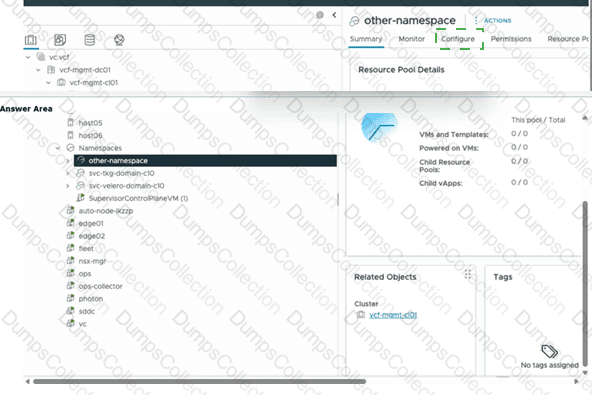
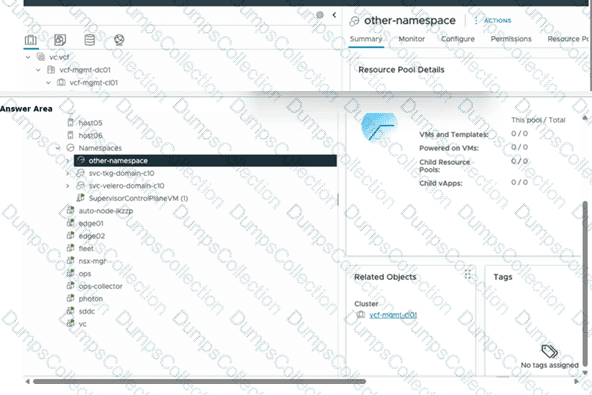
An administrator is tasked to create a new vSphere Zone for the highlighted namespace. Click the section of the interface where the administrator would navigate to start creating a new zone.
Question # 5

Which three objects or object types are within the scope of a cluster backup for VMware vSphere Kubernetes Service (VKS)? (Choose three.)

A.

Objects identified by a label selector

B.

Cluster

C.

Application

D.

Service

E.

Objects identified by a tag

F.

Namespace

Question # 6

An administrator is upgrading an existing VMware vSphere Kubernetes Service (VKS) cluster and receives the following errors:

kubectl get nodes fails with memcache.go and “server is currently unable to handle the request”

couldn ' t get resource list for stats.antrea.tanzu.vmware.com/v1alpha1

yaml: mapping values are not allowed in this context

The administrator successfully updated the Supervisor, but an attempt to update the VKS cluster failed. Based on the scenario, what is the cause of the problem?

A.

The administrator is in the wrong cluster context.

B.

The Kubernetes version being upgraded is no longer supported.

C.

There was an error pulling the update image from the catalog.

D.

The administrator does not have the appropriate permissions to upgrade the cluster.

Question # 7

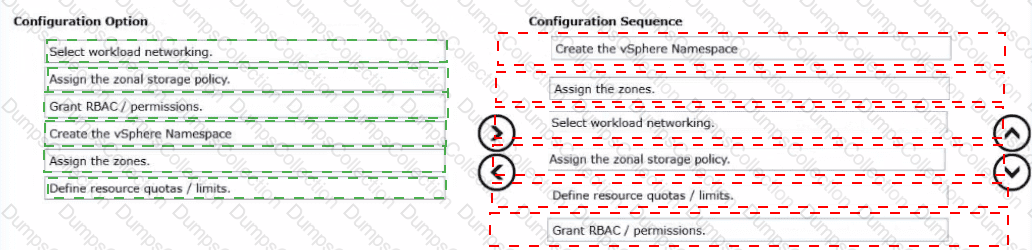
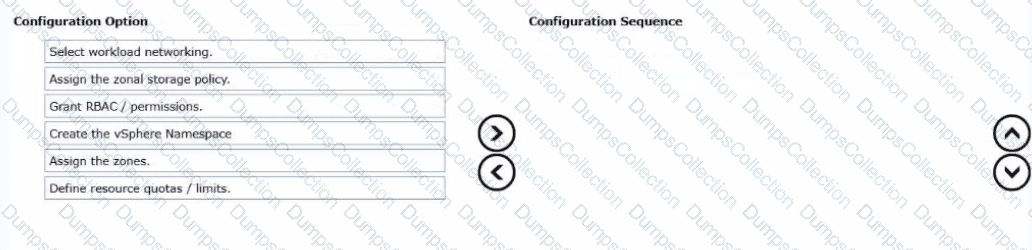
An administrator had deployed a Supervisor cluster on vSphere in a multi-zone-enabled environment and now wants to create a zonal vSphere Namespace so that workloads can be scheduled across zones.

Drag and drop the six actions into the correct order from Configuration Option list on the left and place them Into the Configuration Sequence on the right.

(Choose six.)
Question # 8

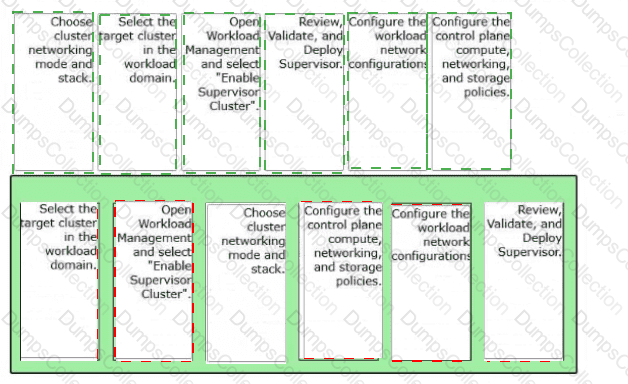
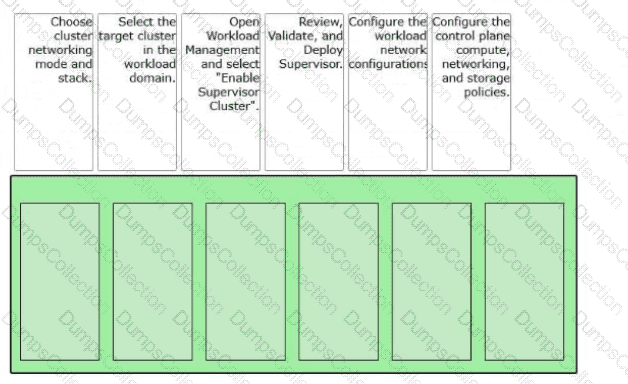
An administrator is tasked with enabling a Supervisor cluster in VMware Cloud Foundation (VCF).

Arrange the steps below In the correct order to complete the process of enabling a Supervisor In the environment.
Question # 9

An administrator is updating a VMware vSphere Kubernetes Service (VKS) cluster by editing the cluster manifest. When saving, there is no indication that the edit was successful.

Based on the scenario, what action should the administrator take to edit and apply changes to the manifest?

A.

Define the KUBE_EDITOR or EDITOR environment variable.

B.

Verify the account editing the cluster manifest has appropriate permissions.

C.

Ensure the file permissions are set to read-write.

D.

Restart the VKS services and edit the file again.

Question # 10

An administrator has been tasked with enabling backup for a vSphere Kubernetes cluster. How does the administrator configure a backup?

A.

Set the BackupStorageLocation in Velero to an S3-compatible object store.

B.

Set the BackupStorageLocation in Velero to use the storage allocated to the namespace for the cluster.

C.

Use vSphere Replication to back up the virtual machines the cluster is deployed on.

D.

Take a vSAN snapshot of the virtual machines the cluster is deployed on.

Page: 1 / 3
Total 24 questions

Most Popular Certification Exams

Payment


Contact us

Site Secure

mcafee secure

TESTED 25 May 2026